
Dr. G. N. Ramachandran was a pioneering Indian biophysicist who founded the Molecular Biophysics Unit at IISc. Trained under Sir C. V. Raman at Cambridge, he became an expert in X-ray crystallography and molecular modeling. He is best known for creating the Ramachandran Plot, a fundamental tool in protein structure analysis, and for proposing the triple-helical structure of collagen. A Fellow of the Royal Society, he is remembered as one of India’s foremost scientists in structural biology.
 Prof.Chandrabhas Narayana, FRSC, FNASc, FASc, is an eminent interdisciplinary scientist renowned for his contributions to Raman spectroscopy, condensed matter physics, materials science and biophysics. He served as Director of the Rajiv Gandhi Centre for Biotechnology (RGCB), Thiruvananthapuram, from November 2020 to September 2025, and held several key academic and leadership positions at the Jawaharlal Nehru Centre for Advanced Scientific Research (JNCASR), Bengaluru. He obtained his Ph.D. in Physics from the Indian Institute of Science (IISc), Bengaluru, and pursued postdoctoral research at Cornell University, USA. His research focuses on the interdisciplinary applications of Raman spectroscopy in drug screening, protein studies and biomedical diagnostics. He has published over 180 research papers, authored four book chapters and holds three international patents. A Fellow of several prestigious scientific academies, he has received numerous awards, including the Sir C. V. Raman Young Scientist Award, C. N. R. Rao Oration Award and Mizushima-Raman Lecture Award. His contributions to scientific innovation, international research collaborations and interdisciplinary research have significantly advanced materials science and biomedical research in India.
The University of Calicut is a prominent higher education institution in Kerala, offering multidisciplinary academic programmes and promoting research and innovation across science, technology, humanities and social sciences. With its strong academic and research environment, the University provides a suitable platform for expert interactions, interdisciplinary discussions and brainstorming sessions on emerging scientific and technological developments.
Date: 8th December 2026 Dr. (Ms.) Govinda Kurup Hemaprabha is an eminent scientist with over three decades of distinguished experience in agricultural research, crop improvement and molecular breeding. She is an elected Fellow of the Indian National Science Academy (2020) and served as the Director of ICAR–Sugarcane Breeding Institute, Coimbatore, from 2021 to 2024. She began her scientific career at the Institute in 1986 and held various positions, including Scientist, Senior Scientist, Principal Scientist and Head-in-Charge of the Division of Crop Improvement, making significant contributions to sugarcane research and varietal development. She has received several prestigious awards and recognitions, including the Lifetime Achievement Award from the Society of Sugarcane Research and Development (2022), the Sir T.S. Venkatraman Award (2016–17), the Noel Deerr Gold Medal and the STAI Silver Medal. She has also contributed to national-level scientific and policy initiatives as a member of the DBT Task Force on Crop Molecular Breeding and as a nominee to the Institute Biosafety Committee of Tamil Nadu Agricultural University. In addition to her research contributions, she has served as the Founder Chief Editor of the Journal of Sugarcane Research and President of the Society of Sugarcane Research and Development, and is a Fellow of several professional societies, including the Indian Society of Genetics and Plant Breeding. Her research interests encompass crop science, plant breeding and crop improvement, with particular emphasis on conventional and molecular breeding approaches, and her scientific expertise and leadership have significantly advanced sugarcane research and agricultural biotechnology in India.
 Professor Ajay K. Sood is a distinguished physicist and one of India's leading scientific figures, currently serving as the Principal Scientific Adviser to the Government of India since April 2022, Chairperson of the Prime Minister's Science, Technology and Innovation Advisory Council (PM-STIAC), and National Science Chair Professor at the Indian Institute of Science (IISc), Bengaluru. He obtained his Ph.D. in Physics from IISc and has made significant contributions to quantum materials, soft matter and active matter, publishing over 495 research papers and holding several patents. He has previously served as President of the Indian National Science Academy (INSA), President of the Indian Academy of Sciences and Secretary-General of The World Academy of Sciences (TWAS). His outstanding contributions have been recognised through prestigious honours, including the Padma Shri, Shanti Swarup Bhatnagar Prize, G. D. Birla Award for Scientific Research and TWAS Prize in Physics. He is a Fellow of the Royal Society, UK, the American Academy of Arts and Sciences and the Australian Academy of Science. Through his contributions to fundamental research, scientific leadership and national science policy, he has played a significant role in strengthening India's science, technology and innovation ecosystem.
 n eminent scientist with an illustrious career in environmental biotechnology, marine environmental research and the application of nuclear and isotopic techniques in food and agriculture. He served as Director of the Biosciences Group at the Bhabha Atomic Research Centre (BARC), Mumbai, and as Senior Professor at the Homi Bhabha National Institute. He has also served as a Raja Ramanna Fellow of the Department of Atomic Energy (DAE), Government of India, and Chairman of the Atomic Energy Education Society, Mumbai. He obtained his Ph.D. from the National Institute of Oceanography, Goa, followed by postdoctoral research at the Technical University of Munich, Germany. His research interests encompass environmental biotechnology, marine environmental science and the application of nuclear and isotopic techniques in food and agriculture. His prestigious recognitions include the Jawaharlal Nehru Memorial Award (1982), Biotechnology Overseas Associateship from the Department of Biotechnology (2000), Group Achievement Award from the Department of Atomic Energy (2013), Elsevier Outstanding Reviewer Award (2015), DAE Raja Ramanna Fellowship (2020) and ISAS Lifetime Achievement Award (2022). He has also made notable contributions to scientific publishing, serving as Associate Editor of Water Research (Elsevier) since 2006 and Consulting Editor of Aquatic Ecology (Springer) from 2006 to 2013, besides editing books published by Springer and CRC Press and reviewing manuscripts for approximately 55 international scientific journals.
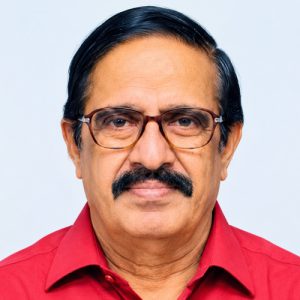 Dr. P. V. Krishnan Nair is an eminent academic, literary scholar and cultural activist from Kerala, with distinguished contributions to Hindi and Malayalam literature, higher education and cultural administration. He obtained postgraduate degrees in Hindi and Malayalam from Cochin University and earned his Ph.D. from Cochin University of Science and Technology (CUSAT) for his research on New Poetry in Hindi – An Aesthetic Study. He served as Professor at Sree Kerala Varma College, Thrissur, and Sree Sankaracharya University of Sanskrit, Kalady, and as Dean of the Faculty of Indian Languages from 2014 to 2016. He also served as Secretary of the Kerala Sahitya Akademi (2001–2006) and Kerala Sangeetha Nataka Akademi (2011–2016), making significant contributions to the promotion of literature and performing arts in Kerala. He has held several important positions in academic, literary and cultural organisations, including the Kendra Sahitya Akademi's Malayalam Advisory Board and the National Book Trust. His extensive experience in literary scholarship, academic leadership and cultural administration reflects his enduring commitment to promoting Indian languages and preserving Kerala's rich literary and cultural heritage.